

When a child screams because the tablet is turned off, drops to the floor when it is time to leave the park, hits when someone gets too close, or throws their homework across the room, it is understandable for a parent to wonder, “Why is my child doing this, and how do I make it stop?” Challenging behaviour can be exhausting. It can make ordinary routines such as getting dressed, doing homework, going grocery shopping, visiting family, or getting out the door feel much harder than they should. One of the most helpful things we can do, however, is shift the question slightly. Instead of starting with “How do I stop this behaviour?”, we can become curious and ask: “Why might this be happening?” And then: “What can I teach my child to do instead?” Research on challenging behaviour has consistently shown that understanding why a behaviour is occurring can help us develop more meaningful and effective ways to support a child. A functional assessment looks beyond what a behaviour looks like and examines the relationship between the behaviour and what is happening around it.
Behaviour Usually Makes More Sense When We Look at the Bigger Picture
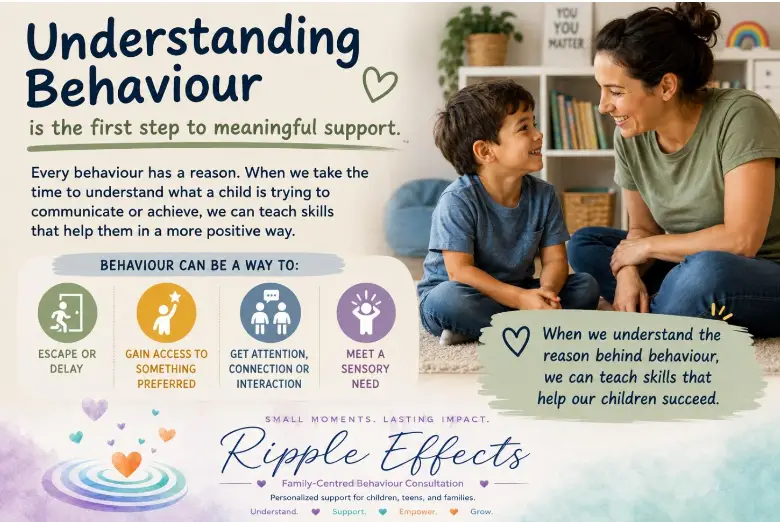
It is easy to describe behaviour by what we see. “He had a meltdown.” “She was refusing.” “He was being aggressive.” “She was looking for attention.” But those descriptions don’t tell us very much about why the behaviour happened. Two children might both scream, but the reasons could be completely different. One child may scream when work becomes too difficult because it has resulted in the work being removed in the past. Another may scream because they don’t yet have an effective way to ask for help. Another may scream when a parent becomes busy because screaming reliably brings the parent back. Still another child may be overwhelmed by noise, uncertainty or a difficult transition. One important thing we have learned from research is that the same behaviour can happen for different reasons—not only for different children, but even for the same child at different times. For example, a child might scream one time because they need help with something that feels difficult. Another time, that same child might scream because they want to get away from or delay a task they have been asked to complete. This is why it is so important to look at what is happening before and after the behaviour, rather than assuming we already know why it is happening. Behaviour analysts therefore look for relationships between behaviour and events in the environment rather than assuming that the behaviour itself tells us its purpose. This means that instead of thinking: My child is doing this because they are being difficult. It can be more useful to think: What Might a Child Be Trying to Accomplish?
The Functions of Behaviour
You may have heard behaviour described using four common functions: attention, access to preferred items or activities, escape or avoidance, and automatic or sensory reinforcement. These categories can be helpful starting points, but real life is often more complicated than four boxes. For example, saying that a behaviour happens “for attention” doesn’t tell us whether a child wants reassurance from Mom, help from Dad, laughter from a sibling, comfort after becoming upset, or simply connection with someone they care about. Sometimes a behaviour doesn’t fit neatly into just one category. Behaviour can happen for more than one reason, and those reasons can work together. For example, a child might scream when given a difficult task because screaming has helped them get away from the task and gain access to a preferred activity or item. Another child might refuse to get ready for school because it delays leaving home while also allowing them to continue doing something they enjoy. Looking at the whole situation—what happened before the behaviour, what the child did, and what happened afterward—can help us better understand what the behaviour may be accomplishing for that child in that moment. For parents, the important message is: Your child’s behaviour may not fit neatly into a category, and that’s okay. The goal isn’t to quickly label a behaviour as “attention seeking” or “escape.” The goal is to become curious about the pattern.
Becoming a Behaviour Detective
One simple way to start looking for patterns is to think about three things: What happened before? → What did my child do? → What happened afterward? Functional behaviour assessments gather information about these events to help develop hypotheses about what may be influencing challenging behaviour. Parents don’t need to turn family life into a research project. You can simply start noticing. Here’s a different everyday example that may feel more relatable to families: What happened before? Your child was playing a favourite video game and was told it was time to turn it off and get ready for bed. What happened? Your child began yelling and arguing. What happened next? The parent gave them another 10 minutes on the game. If this happens regularly, you might begin to wonder whether yelling and arguing have become an effective way for your child to delay the transition and continue accessing something they enjoy. This doesn’t mean that one situation tells us exactly why a behaviour is happening. Instead, it gives us clues and helps us start looking for patterns over time.
Look at the Context Too
Behaviour doesn’t happen in a vacuum. Children may behave differently depending on:
- who is with them,
- where they are,
- how difficult the expectation is,
- how predictable the situation feels,
- whether they are tired or hungry,
- how much support is available, or
- what they have learned will happen in that particular situation.
The person, place, and situation can all influence why a behaviour is happening. A child may use a behaviour for one reason at home and for a different reason at school or in the community. They may also respond differently depending on who they are with, what is being asked of them, and what typically happens afterward. This is why looking at the situation surrounding the behaviour can be just as important as looking at the behaviour itself. So, if your child manages something successfully at school but struggles with the same activity at home, or behaves differently with one caregiver than another, it doesn’t automatically mean anyone is doing something wrong. Instead, it gives us another question to explore: “What is different about these situations?” Maybe school provides a visual schedule. Maybe expectations are clearer. Maybe home comes at the end of a very demanding day. Maybe one adult provides more warning before transitions. Maybe one environment is quieter. Those differences can provide valuable clues.
Instead of Asking “How Do I Stop This?” Ask “What Can I Teach?”
Once we have an idea about what a behaviour may be accomplishing, the next question becomes much more useful: What skill could help my child accomplish the same thing in a safer or more effective way? Functional Communication Training, or FCT, is based on a simple idea: teach the child an easier and more appropriate way to communicate what they need or want. The new communication skill should help the child accomplish the same thing that the challenging behaviour was helping them accomplish. For example, if a child screams when work becomes too difficult and this leads to a break, we might teach them to say, “Can I have a break?” instead. Over time, the child can learn that communicating their needs is a more effective way to get help, ask for space, request a break, or let others know what they need. If speaking is difficult for your child, the communication response doesn’t have to be spoken. A gesture, picture, communication device, sign or another response that other people can easily understand may be more appropriate. The important part is that the new response needs to work for the child. If we teach a child to request a break but a break is never available, throwing the worksheet may still be a much more effective way of escaping work. It is important to understand what the child is trying to accomplish through the behaviour so that we can teach another way to meet that same need. A new skill is more likely to be useful when it actually works for the child. For example, if a child is yelling because they need help, teaching them to ask for a break may not solve the problem—they may need to learn how to ask for help instead.
Sometimes the Solution Is Not Just Teaching the Child
Understanding behaviour also means being willing to look at the environment. Not every difficulty needs to be solved by asking the child to tolerate more. If transitions are difficult, we might provide more predictability through visual schedules, countdowns, warnings and meaningful choices. Instead of suddenly saying: “Tablet off. Time to go.” we might say: “Five more minutes, then shoes.” Then: “Two more minutes.” And when it is time: “Do you want to turn the tablet off yourself, or would you like me to do it?” If waiting is difficult, we can teach it gradually rather than expecting a child who struggles to wait to suddenly tolerate ten or twenty minutes. Start with a wait the child can realistically manage—perhaps only a few seconds—and gradually increase it as they experience success. If behaviour consistently produces adult attention, look for opportunities to give positive attention when the child asks to play, shares something, tells you a story or seeks connection in another way. The goal isn’t to withhold warmth or connection. It is to help the child discover: “There are easier and more successful ways to get someone’s attention.” And if your child appears overwhelmed, consider whether something about the situation itself could reasonably change. Could the task be broken into smaller steps? Could the noise be reduced? Could you provide a visual? Could you offer help sooner? Could the child choose where to sit? Could the expectation wait until they are calmer? Sometimes changing an environment isn’t “giving in.” It is making the environment more accessible so the child can be successful.
Asking for a Break Is a Skill
Parents sometimes worry that teaching a child to ask for a break might encourage them to avoid anything they find difficult. However, asking for a break can be an important skill that helps a child communicate when they need a little time before continuing. For example, one young child was having significant challenging behaviour when he wanted to get away from tasks. His mother taught him a more appropriate way to ask for a break, while also helping him gradually learn to complete tasks more independently. Over time, his challenging behaviour decreased, he became better at asking for breaks, and he completed more tasks on his own. These positive changes continued over time. Teaching a child to ask for a break doesn’t mean removing expectations altogether. Instead, it gives them a safer and more effective way to communicate that something is difficult, while we continue helping them build the skills they need to manage those situations successfully. So teaching “I need a break” doesn’t have to mean removing every expectation. It can mean teaching a child: “You don’t need to hit, scream, throw or run away to tell us that something is too hard. There is another way to communicate that.” Once that communication is working reliably, families and clinicians can gradually work on flexibility, waiting, persistence and returning to activities when appropriate.
Parents Are an Important Part of Understanding Behaviour
Parents know details about their children that may be difficult to recreate in a clinic or brief appointment. You know that your child struggles more after a poor night’s sleep. You know the difference between the way they ask for help and the way they behave when they have had enough. You may know that getting dressed is easy on Saturday but extremely difficult on a rushed school morning. Parents and caregivers can play an important role in understanding their child’s behaviour because they know their child and see them across many everyday situations. They can often help identify patterns, such as when a behaviour is more likely to happen, what tends to happen beforehand, what their child may be trying to communicate, and what seems to help. With guidance from a qualified professional, parents can also learn strategies that help their child communicate their needs in safer and more effective ways. For example, parents may be supported in teaching their child to ask for help, request a break, ask for attention, or communicate that they need space. When these new skills are useful and work for the child, challenging behaviour may decrease while communication increases. This doesn’t mean parents are expected to figure everything out or manage complicated behaviour concerns on their own. A behaviour analyst can help identify patterns, develop an individualized plan, teach parents how to use the strategies, and make adjustments when something isn’t working. Parents can be incredibly valuable observers and partners without needing to become their child’s clinician.
What Parents Can Try at Home
For everyday, lower-risk behaviour, a helpful starting point can be: 1. Get curious before reacting. Ask yourself what happened immediately before the behaviour and what usually happens afterward. 2. Look for patterns. Does it happen during difficult work? When attention is elsewhere? When something ends? During waiting? In noisy places? With particular people? 3. Make communication easier. Teach simple phrases, gestures, visuals or AAC responses such as help, break, wait, my turn, more, all done, space, or not yet. 4. Make the new skill worth using. When your child uses the appropriate communication response, respond when you reasonably can so they learn that communication works. 5. Prevent problems when possible. Use predictability, visuals, choices, smaller steps, warnings and environmental changes rather than waiting until your child is already overwhelmed. 6. Build difficult skills gradually. Waiting, transitioning, accepting “not right now,” completing work and tolerating changes are skills. Skills develop through practice, not simply by being demanded. 7. Notice what is going well. Give attention to asking appropriately, coping with a change, waiting for a few seconds, requesting help or taking a break safely.
Understanding Behaviour Doesn’t Mean Allowing Everything
Looking for the reason behind behaviour doesn’t mean that hitting is okay, property destruction has to be accepted, or children should never experience expectations. Understanding function simply helps us respond more effectively. We can maintain boundaries while also asking: “What does my child need to learn to handle this situation more successfully next time?” That might involve learning to wait. It might involve communicating “no” appropriately. It might involve tolerating a short delay. It might involve asking for help. It might involve completing part of a difficult activity before taking a break. Or it might involve adults recognizing that an expectation or environment needs to be adjusted. The goal isn’t to make challenging behaviour disappear at any cost. The goal is to help the child develop safer, clearer and more effective ways to navigate the situations that are difficult for them.
A Different Way of Looking at Challenging Behaviour
When challenging behaviour is happening in front of us, it is natural to focus on stopping it. But behaviour research gives us another option. We can pause long enough to wonder: What is making this situation difficult? What are they trying to communicate, access, avoid or change? Is there something about the environment that I can make easier? And perhaps most importantly: What skill can I teach that will work better? Changing that question doesn’t mean ignoring challenging behaviour or allowing it to continue. It means looking beyond the behaviour to the child who is still learning how to communicate, cope, wait, transition, ask for help, handle disappointment and navigate a complicated world. When we look beyond the behaviour and try to understand what our child needs in that moment, we can focus on teaching skills that help them communicate, cope, and navigate difficult situations more successfully.
When to Seek Additional Support
Parents can learn a great deal by observing patterns, but identifying the function of behaviour isn’t always straightforward. Research has shown that behaviour can be influenced by very individualized variables and may sometimes differ across settings and people. If behaviour is frequent, increasing, significantly interfering with daily life, or involves aggression, self-injury, elopement or other safety concerns, an individualized assessment by a qualified professional may be appropriate.
A Personal Note
In my work with children and families, I have seen how easy it can be to focus on the behaviour we want to stop, especially when that behaviour is making everyday life challenging. When a child is screaming, refusing, hitting, throwing things, or struggling through a routine, our first thought is often, “How do we get this to stop?” But I have found that some of the most meaningful progress happens when we become curious about why the behaviour is happening in the first place. Challenging behaviour does not mean that a child is being difficult or that a parent is doing anything wrong. Sometimes a child simply does not yet have the skills they need to communicate what they want, ask for help, handle disappointment, wait, transition, or cope with something that feels overwhelming. For me, behaviour support is not just about reducing behaviour. It is about understanding the individual child, looking at what may be making a situation difficult, and helping them learn skills that make everyday life easier and more successful. Sometimes that means teaching a new way to communicate. Sometimes it means changing how we approach a task or transition. And sometimes it means recognizing that the environment or expectation needs to change too. Parents know their children in ways that no professional ever can. When we combine that knowledge with thoughtful observation and individualized support, we can move away from simply asking “How do we stop this?” and toward a much more helpful question: “What does this child need to be successful?” — Karen Palmer, MSc., RBA (Ont.), BCBA Ripple Effects Behaviour Consultation
If you are looking for individualized support in understanding your child’s behaviour, learn more about the services offered through Ripple Effects Behaviour Consultation.Further Reading
Davis, T. N., Gerow, S., Wicker, M., Cosottile, D., Exline, E., Swensson, R., & Lively, P. (2022). Utilizing telehealth to coach parents to implement trial-based functional analysis and treatment. Journal of Behavioral Education. Germansky, S., Reichow, B., Martin, M., & Snyder, P. (2020). A systematic review of caregiver-implemented functional analyses. Behavior Analysis in Practice, 13, 698–713. Hanley, G. P., Iwata, B. A., & McCord, B. E. (2003). Functional analysis of problem behavior: A review. Journal of Applied Behavior Analysis, 36(2), 147–185. Harding, J. W., Wacker, D. P., Berg, W. K., Lee, J. F., & Dolezal, D. (2009). Conducting functional communication training in home settings: A case study and recommendations for practitioners. Behavior Analysis in Practice, 2(1), 21–33. Roscoe, E. M., Schlichenmeyer, K. J., & Dube, W. V. (2015). Functional analysis of problem behavior: A systematic approach for identifying idiosyncratic variables. Journal of Applied Behavior Analysis, 48(2), 289–314. Tiger, J. H., Hanley, G. P., & Bruzek, J. (2008). Functional communication training: A review and practical guide. Behavior Analysis in Practice, 1(1), 16–23.