

Compassion: Why Modern ABA Is About More Than Teaching Skills
Compassion in ABA is increasingly recognized as an essential part of respectful, meaningful support for children and families. Applied Behavior Analysis (ABA) often brings a variety of opinions and experiences. Many families have seen their children make meaningful progress through ABA, while others have concerns based on past experiences or stories they have heard. Like every profession, ABA has evolved over time, and continued growth has been shaped by listening to families, autistic individuals, advocates, and professionals. These conversations have strengthened the field by encouraging reflection, collaboration, and a greater focus on compassionate, person-centred care.
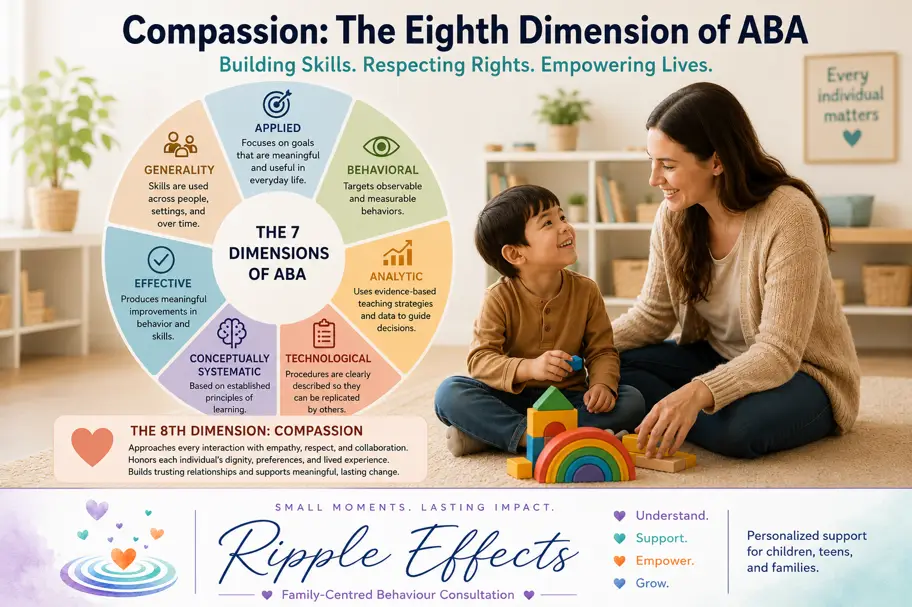
What Are the Seven Dimensions of ABA
Since the late 1960s, the science of ABA has been guided by seven core dimensions that ensure intervention is evidence-based, effective, and focused on improving everyday life. These dimensions describe what high-quality ABA should look like.
- Applied: Programs should focus on goals that matter in daily life.
- Behavioural: rely on observable and measurable behaviours.
- Analytic: use scientifically supported teaching methods.
- Technological: clearly describe procedures so they can be replicated.
- Conceptually Systematic: be based on established principles of learning.
- Effective: produce meaningful improvements.
- Generality: promote skills that continue across people, settings, and time.
These seven dimensions have provided the foundation of ABA for decades and continue to guide best practice today. However, as the field has grown, so has the understanding that effective teaching alone is not enough. Families, autistic adults, advocates, and behaviour analysts have all contributed valuable perspectives that have encouraged the profession to reflect on how services are delivered. These conversations have highlighted that while a program may meet all seven dimensions, it may still fall short if it does not fully consider the individual’s dignity, preferences, and lived experience.
Why Compassion Matters
This has led some leaders in the field to advocate for an eighth dimension of ABA—Compassion. Compassion is not simply about being kind or caring. It means actively listening to the individual and their family, understanding their experiences, respecting their values, and building genuine partnerships throughout the learning process. Compassion encourages behaviour analysts to approach every interaction with humility, recognizing that families and individuals are experts in their own lives. Rather than deciding what should be important, compassionate ABA asks what is meaningful to the individual and works together to achieve those goals.
Adding compassion as an eighth dimension strengthens every other aspect of ABA. When intervention is compassionate, goals become more meaningful because they reflect the priorities of the individual and their family. Teaching strategies become more respectful because they recognize communication, emotions, and behaviour as valuable sources of information to help guide the goal development process. Data collection remains important, but it is balanced with listening, collaboration, and ongoing feedback from the people receiving services. Success is measured not only by skill acquisition but also by increased confidence, independence, participation, and overall quality of life.
Compassion and Neurodiversity
Compassion also aligns naturally with the growing understanding of neurodiversity. Every individual experiences the world differently, and those differences deserve respect. Compassionate ABA recognizes that therapy should never focus on making someone appear “less autistic” or encouraging them to fit a predetermined standard of what is considered typical. Instead, intervention should support skills that increase independence, improve communication, enhance safety, strengthen relationships, and help individuals participate more fully in the activities that are meaningful to them. At the same time, professionals should consider whether changes to the environment, increased education and acceptance, or additional accommodations may be just as important as teaching new skills.
Protecting Children’s Rights
Children also have fundamental rights that should be protected throughout every stage of intervention. They deserve to be treated with dignity, have opportunities to make choices, express preferences, communicate in ways that work best for them, and participate in decisions whenever possible. Therapy should support emotional well-being just as much as skill development. When children feel heard, respected, and safe, learning becomes more meaningful, and trusting relationships naturally develop between families and professionals.
What This Means for Families
The future of ABA is not about replacing the science that has guided the profession for decades. Instead, it is about building upon that strong scientific foundation by placing compassion alongside the original seven dimensions. Evidence-based teaching strategies remain essential, but they are most effective when delivered with empathy, collaboration, humility, and respect for each person’s individuality. By embracing compassion as an essential dimension of practice, ABA continues to evolve into a profession that not only teaches meaningful skills but also empowers individuals, strengthens families, and improves quality of life in ways that truly matter.
A Personal Note
Every family deserves to feel heard, respected, and supported. Seeking services for your child can feel overwhelming, especially when there is so much information—and sometimes misinformation—available. My hope is that this information helps families better understand what modern, compassionate ABA looks like and the values that guide quality practice today.
At Ripple Effects Behaviour Consulting, every child is viewed as an individual with unique strengths, interests, and goals. Therapy is never about changing who someone is. It is about building meaningful skills, supporting independence, fostering confidence, and improving quality of life while respecting each person’s individuality.
Thank you for taking the time to read this post. Whether you’re just beginning your journey or looking for a different approach, I hope you’ll continue exploring the resources on this website. If you have questions or would like to learn more about how compassionate, family-centred, and neurodiversity-affirming ABA can support your child, I’d love to connect with you.
— Karen Palmer, MSc., RBA (Ont.), BCBA
Ripple Effects Behaviour Consultation
Further Reading
The philosophy described above is informed by current research and ongoing discussions within the field of Applied Behavior Analysis. Families who are interested in learning more may find the following articles helpful:
Allen, L. L., Mellon, L. S., Syed, N., Johnson, J. F., & Bernal, A. J. (2024). Neurodiversity-affirming applied behavior analysis. Behavior Analysis in Practice, 19, 302–324. https://doi.org/10.1007/s40617-024-00918-0
Cianci, R. A., & Sevon, M. A. (2023). An introduction to a child’s rights approach to applied behavior analysis. Behavior Analysis in Practice, 19, 291–301. https://doi.org/10.1007/s40617-023-00867-0
Penney, A. M., Bateman, K. J., Veverka, Y., Luna, A., & Schwartz, I. S. (2023). Compassion: The eighth dimension of applied behavior analysis. Behavior Analysis in Practice, 19, 59–73. https://doi.org/10.1007/s40617-023-00888-9