

Simple, practical ways to make routines, transitions and everyday challenges a little easier for your child—and for you.
Family life is full of transitions, routines, waiting, unexpected changes, and things that simply have to get done. Getting dressed, leaving the house, turning off a favourite show, brushing teeth, waiting for dinner, getting into the car, or moving from one activity to another may seem like small parts of the day. But for some children, these moments can be genuinely difficult.
When a child is struggling, it can be tempting to think that we need a complicated behaviour plan or a completely new routine. Often, however, some of the most helpful strategies are also some of the simplest.
A picture that shows what is happening next. A choice between two shirts. A timer that makes an abstract idea like “five more minutes” something the child can see. Showing a child how to do something instead of repeating the instruction. Giving them an easy way to ask for help.
Small changes like these can make everyday expectations easier to understand and give children more opportunities to communicate, participate and be successful.
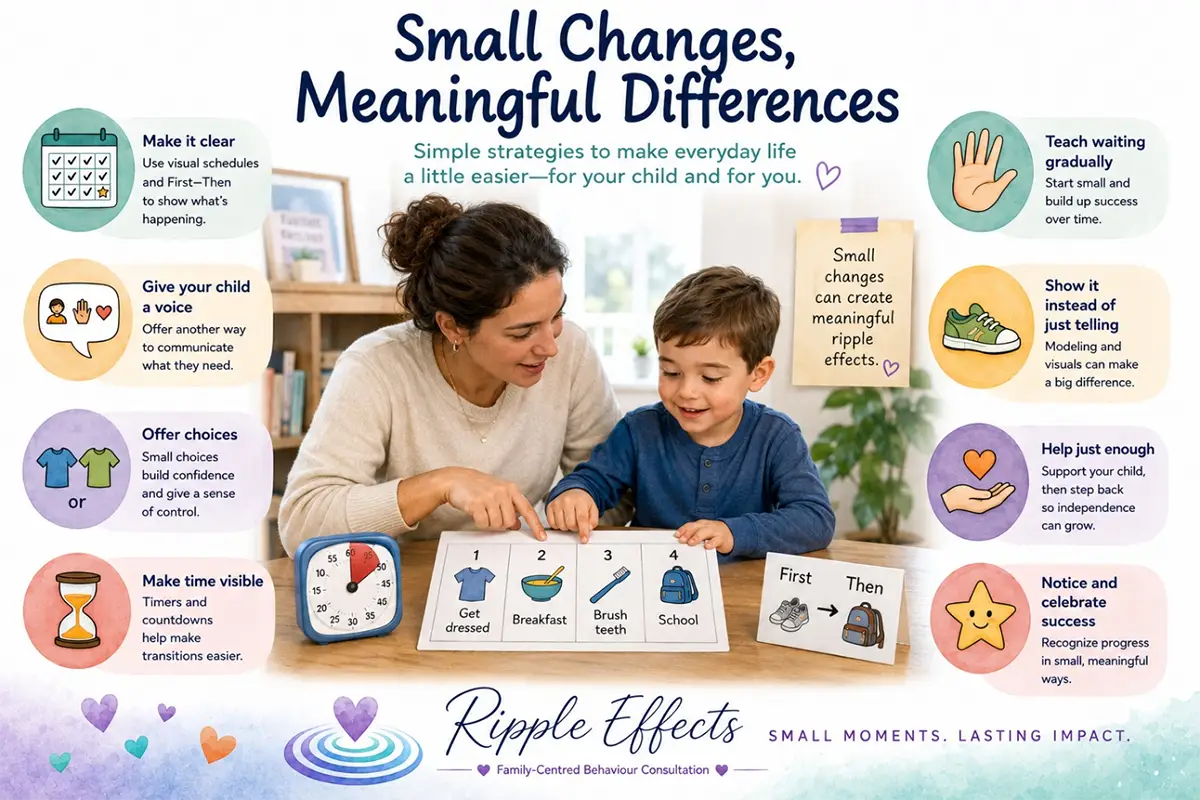
Make Things Understandable: Visual Schedules
Adults often keep the plan for the day in their heads. Children don’t have access to that information unless we share it with them.
A visual schedule is one way to make the plan visible.
It doesn’t need to be elaborate. Depending on the child, a schedule might use photographs, simple pictures, symbols or written words. It could show an entire morning or just the next three things that are going to happen.
For example:
Get dressed → Eat breakfast → Brush teeth → School
A bedtime schedule might be:
Bath → Pajamas → Brush teeth → Story → Bed
Visual schedules can help children understand what is happening now, what is coming next and when something is finished. They can also reduce the need for adults to repeatedly give verbal reminders.
For some children, seeing information is simply easier than having to remember a series of spoken instructions.
Keep the schedule at a level your child can understand. If five pictures are overwhelming, start with two. If photographs make more sense than symbols, use photographs. The goal isn’t to create the perfect visual schedule. The goal is to make their day a little easier to understand.
Keep It Simple: First–Then
Sometimes a full schedule isn’t necessary. A child may only need to know two things:
What do I need to do now?
and
What happens after that?
This is where First–Then can be helpful.
For example:
First shoes, then outside.
First teeth, then story.
First get dressed, then breakfast.
First–Then language works best when it is clear and realistic. The “then” should also be something that is actually going to happen—not a promise we might not be able to keep.
And First–Then doesn’t always have to mean “First something you don’t like, then something you love.” It can simply help organize information:
First, we’re going to Grandma’s house, then we’re going to the grocery store.
Sometimes knowing the order is helpful all by itself.
Give Your Child a Voice: Simple Picture Communication
Communication is much bigger than spoken words.
Some children may have difficulty telling us what they need. Others may communicate well most of the time but find speaking much harder when they are overwhelmed, frustrated, tired or upset.
Pictures can provide another way to communicate.
This does not have to involve an electronic communication device or a complicated communication system. A simple page or small set of pictures could include things that are particularly useful for your child, such as:
- Help
- Break
- More
- Finished
- Yes/No
- Drink
- Snack
- Play
You can also include pictures of favourite toys, foods, activities, people or places.
A child can point to, touch, or hand over a picture to communicate.
The important part is what the picture allows the child to say.
If your child points to BREAK, whenever possible, honour that communication or let them know when a break will be available.
If they indicate HELP, help them.
If they communicate NO, acknowledge that you heard them—even when the answer cannot always be a yes to their “no.” If honouring the request is not possible at that time, this is when First-Then language can be helpful.
Communication becomes meaningful when children learn that communicating changes what happens around them.
Give Your Child Some Control: Offer Meaningful Choices
Children spend much of their day being told what to do.
Get dressed.
Put your shoes on.
Come here.
Get in the car.
Eat your breakfast.
Clean up.
It’s understandable that adults make many decisions for children. But wherever we reasonably can, we can also create opportunities for children to have some control over their own day.
Choices can be very small:
Blue shirt or green shirt?
Apple or banana?
Bath first or snack first?
Markers or crayons?
Do you want to walk to the car or hold my hand?
For children who have difficulty understanding spoken choices, show them the actual items or pictures of the options.
Meaningful choice isn’t about letting children decide everything. There will always be things that aren’t optional.
Instead, look for the parts that can be flexible.
Maybe brushing teeth isn’t optional, but the child can choose the toothbrush or the colour of the cup to rinse their mouth.
Leaving for school isn’t optional, but they can choose what shoes to wear or which song plays in the car.
Giving children genuine opportunities to choose helps them practise communicating preferences and can support growing independence and autonomy.
Make Time Easier to Understand: Timers and Countdowns
“Five more minutes.”
“We’re leaving soon.”
“You can have it later.”
“Just wait a little bit.”
These statements make sense to adults because we understand time. For a child, however, words like soon, later and a few minutes can be very abstract.
A timer can make time more concrete.
If your child is playing and needs to leave in five minutes, try setting a timer and saying:
“Five more minutes. When the timer is finished, it’s time for shoes.”
Some children benefit from additional reminders:
“Two minutes left.”
“One more minute.”
Then follow through when the timer ends.
Visual timers (found on Amazon for less than $20) can be particularly helpful because the child can actually see the amount of time getting smaller.
A timer can help your child understand what is happening and when a change is coming, making transitions feel a little more predictable and manageable.
Teach Waiting Gradually
Waiting is a skill—and like other skills, it may need to be taught.
Imagine asking a child who currently finds waiting 10 seconds very difficult to suddenly wait 20 minutes for their tablet. That isn’t really giving them an opportunity to practise successfully.
Instead, start with an amount of waiting the child can manage.
A child might ask for a favourite toy and hear:
“Yes. Wait.”
Then, after a very short wait:
“Great waiting—here it is!”
Once short waits are going well, gradually make them a little longer.
A visual timer or a simple WAIT card can help make it clear that the preferred item isn’t gone forever—it just isn’t available yet.
The goal isn’t to see how long a child can tolerate being without something they enjoy. The goal is to teach the skill of waiting in small, achievable steps.
If your child is consistently becoming very upset, the step may be too big. Make it smaller and build from success (if 1 minute is too long, try 45 seconds).
Show Instead of Only Telling: Modeling
Sometimes adults find themselves repeating the same instruction:
“Put your coat on.”
“Put your coat on.”
“Come on, coat on.”
“Remember what I said?”
If the child doesn’t know exactly what to do—or doesn’t understand the instruction—saying it more times may not make it clearer.
Sometimes it is more helpful to show them.
Modeling simply means demonstrating the skill you want the child to learn.
If you’re teaching your child how to put their dishes in the dishwasher, show them.
If you’re teaching how to pack a backpack, demonstrate it.
If you’re teaching how to greet someone, you can model what that might look like.
Another option is video modeling. A short video can show the child (with help) or another person completing the activity successfully. The child can watch the video before trying it themselves.
You don’t need professional videos. For some skills, a short video recorded on your phone may be enough.
The goal is to change:
“I’ve told you five times.”
into:
“Let me show you.”
Help Just Enough: Prompting
When children are learning something new, they may need help.
That help is called a prompt.
A prompt could be:
- pointing toward the shoes,
- showing a picture,
- demonstrating what to do,
- giving a short verbal reminder,
- gesturing toward the next step,
- or providing other assistance appropriate for that child.
The important part is to give enough help for the child to succeed without automatically doing everything for them.
For example, imagine you tell your child, “Get dressed.” Your child may understand the instruction but still needs some help completing the steps.
At first, you might hand them their shirt or gently help them get it started. For the next item, you might simply point toward their pants. As they become more familiar with the routine, you might only gesture toward the pile of clothes or look toward the next item they need.
Over time, you can gradually step back and provide less help, giving your child more opportunities to complete each part of getting dressed independently.
It can also be helpful to pause before stepping in. Sometimes a child knows what to do but needs a little more time to understand the instruction, remember the next step, organize their thoughts, or get their body started.
Giving those few extra seconds can sometimes be all the help they need.
The idea is to offer the amount of help your child needs to be successful, gradually step back as they learn, and give them opportunities to discover just how much they can do for themselves.
Notice and Strengthen Success: Reinforcement
When your child does something you would like to encourage more of, what happens next can make a difference in whether they are likely to do it again.
Simply put, what happens after a behaviour can influence whether that behaviour happens more often in the future.
Suppose your child asks for help instead of throwing their homework on the floor.
You respond:
“Absolutely. Thanks for asking me for help.”
Then you help them.
If asking for help begins happening more often, your response helped strengthen that communication.
Or perhaps your child gets dressed independently and you notice:
“You got completely dressed by yourself this morning!”
Your child smiles and independent dressing begins happening more frequently.
What is reinforcing will be different for every child. It might be:
- attention,
- praise,
- playing together,
- a favourite activity,
- movement,
- music,
- a favourite toy,
- getting to choose what happens next,
- access to something they requested,
- or simply the natural outcome of what they did.
Try to notice the behaviours you want to see more often.
If your child waits for five seconds when waiting is difficult, notice it.
If they point to HELP instead of becoming increasingly frustrated, respond to it.
If they try one step of a new routine independently, acknowledge the effort.
Success doesn’t have to be perfect before it is worth noticing.
And Parents Need Support Too
There is another person in all of these routines who matters: you.
Parenting can be exhausting. When you’re trying to get everyone out the door, your child is upset, someone can’t find their shoes and you’re already late, knowing the “right strategy” doesn’t magically make the situation easy.
You will have days when you are patient and calm.
You will also have days when you’re tired, frustrated or overwhelmed.
Be kind to yourself.
When it is safe to do so, it is okay to take a moment. Step into another room. Take a few slow breaths. Get a drink of water. Ask another adult to take over if someone is available. Give yourself a few minutes before trying again.
Children often rely on the adults around them to help bring calm and predictability to difficult moments. When we are highly upset ourselves, it becomes much harder to offer that calm support.
That doesn’t mean parents need to remain perfectly calm all the time. That’s an unrealistic expectation.
It means your regulation matters too.
Taking care of yourself isn’t separate from supporting your child. Sometimes taking a short break is exactly what allows you to come back and respond in the way you wanted to.
And if a routine falls apart today, you can try again tomorrow.
Bringing It All Together
Supporting a child doesn’t always require a complicated program. Sometimes we can begin by asking:
What could make this situation easier for my child to understand, communicate about or successfully participate in?
Then consider a small change:
Make things understandable → use visual schedules and First–Then.
Give your child a voice → provide pictures and other ways to communicate.
Give your child some control → offer meaningful choices.
Make time understandable → use timers and countdowns.
Teach waiting gradually → build tolerance for delays in small, achievable steps.
Show instead of only telling → use modeling or video modeling.
Help just enough → prompt when needed and gradually reduce the help.
Notice and strengthen success → respond to the behaviours and communication you want to help grow.
None of these strategies needs to be perfect.
You also don’t need to introduce all of them at once.
Pick one part of the day that is difficult and think about one small thing you could change. Maybe tomorrow morning you put out two shirts and let your child choose. Maybe you take photographs for a three-step bedtime schedule. Maybe you add a picture for BREAK to the refrigerator. Maybe you start giving a five-minute warning before screen time ends.
Small changes may not make every difficult moment disappear. But they can make everyday life a little more understandable, predictable and manageable—and give children more opportunities to communicate, make choices, learn new skills and experience success.
A Personal Note
In my work with children and families, I see how much time, energy and thought parents put into supporting their children every day. So much of that work happens quietly—preparing for difficult transitions, repeating instructions, attending appointments, communicating with schools and professionals, trying different strategies, advocating for their child, managing family responsibilities, and continually trying to figure out what might make things a little easier.
With so many recommendations, programs and opinions coming from different directions, it can sometimes feel as though there is always one more thing parents are supposed to be doing. Strategies that are intended to help should never become another source of pressure or leave parents feeling that they aren’t doing enough.
I don’t believe support needs to look perfect to be meaningful.
Often, the most helpful changes are surprisingly small. It might be changing how we give an instruction, putting a picture where a child can easily see it, offering another way to ask for help or a break, waiting a few extra seconds before stepping in, or simply noticing a small success that might otherwise have been missed. These aren’t about doing more. Sometimes they are about finding a simpler way to support something you are already working incredibly hard to help your child learn.
I also believe parents deserve the same patience and compassion that we encourage them to offer their children. Parenting can be rewarding, but it can also be exhausting. Parents get tired. They become frustrated and overwhelmed. They need rest, support and breaks too. Taking care of yourself doesn’t take away from the support you give your child—it helps make that support sustainable.
There will be difficult days. A strategy that worked yesterday might not work today. You may lose your patience, change the plan, decide something isn’t worth the battle that day, or simply need to take a break and try again later. None of that takes away from the many things you do for your child every day.
The goal isn’t a perfectly calm child, a perfectly organized home, or a parent who always knows exactly what to do. It is to continue learning about your child, finding what works for your family, making changes when they are helpful, and recognizing the progress that can easily get lost in the demands of everyday life.
Sometimes progress is a smoother transition. Sometimes it’s a child finding a new way to say, “I need help.” Sometimes it’s a parent recognizing that everyone has had enough and deciding to try again tomorrow.
Those moments matter.
Sometimes the smallest changes can create meaningful ripple effects—not only for a child, but for the whole family.
— Karen Palmer, MSc., RBA (Ont.), BCBA
Ripple Effects Behaviour Consultation
If you are looking for individualized support in understanding your child’s behaviour, learn more about the services offered through Ripple Effects
Further Reading
Brewer, A. T., Strickland-Cohen, K., Dotson, W., & Williams, D. C. (2014). Advance notice for transition-related problem behavior: Practice guidelines. Behaviour Consultation.Behavior Analysis in Practice, 7, 117–125. https://doi.org/10.1007/s40617-014-0014-3
Cho, S., Noor, N. H. B. M., & Sonoyama, S. (2017). A review of activity schedules for individuals with autism spectrum disorder. Journal of Special Education Research, 5(2), 65–76. https://doi.org/10.6033/specialeducation.5.65
Herrod, J. L. (2022). The effects of the Premack principle on on-task behavior, challenging behavior, and correct responding [Doctoral dissertation, University of Georgia].
Hume, K. (2008). Transition time: Helping individuals on the autism spectrum move successfully from one activity to another. Indiana Resource Center for Autism, Indiana Institute on Disability and Community, Indiana University. Read Transition Time
Iacono, T., Trembath, D., & Erickson, S. (2016). The role of augmentative and alternative communication for children with autism: Current status and future trends. Neuropsychiatric Disease and Treatment, 12, 2349–2361. https://doi.org/10.2147/NDT.S95967
Kim, J. Y., Morris, C., Ellsworth, M. E., Liu, X., & Seacord, N. F. (2025). Choice versus no choice: Practical considerations for increasing choices. Journal of Applied Behavior Analysis, 58, 100–117. https://doi.org/10.1002/jaba.2920
Kranak, M. P., & Brown, K. R. (2024). Updated recommendations for reinforcement schedule thinning following functional communication training. Behavior Analysis in Practice, 17, 87–106. https://doi.org/10.1007/s40617-023-00863-4
Quigley, J., Griffith, A. K., & Kates-McElrath, K. (2018). A comparison of modeling, prompting, and a multi-component intervention for teaching play skills to children with developmental disabilities. Behavior Analysis in Practice, 11, 315–326. https://doi.org/10.1007/s40617-018-0225-0
Rajaraman, A., Austin, J. L., & Gover, H. C. (2023). A practitioner’s guide to emphasizing choice-making opportunities in behavioral services provided to individuals with intellectual and developmental disabilities. International Journal of Developmental Disabilities, 69(1), 101–114. https://doi.org/10.1080/20473869.2022.2117911
Reinert, K. S., Higbee, T. S., & Nix, L. D. (2020). Creating digital activity schedules to promote independence and engagement. Behavior Analysis in Practice, 13, 577–595. https://doi.org/10.1007/s40617-020-00437-8
Sam, A., & AFIRM Team. (2015). Reinforcement. National Professional Development Center on Autism Spectrum Disorder, FPG Child Development Center, University of North Carolina.
Weyman, J. R., Imler, M., & Kelly, D. A. (2024). Addressing prompt dependency in the treatment of challenging behavior maintained by access to tangible items. Behavioral Sciences, 14(9), 828. https://doi.org/10.3390/bs14090828